

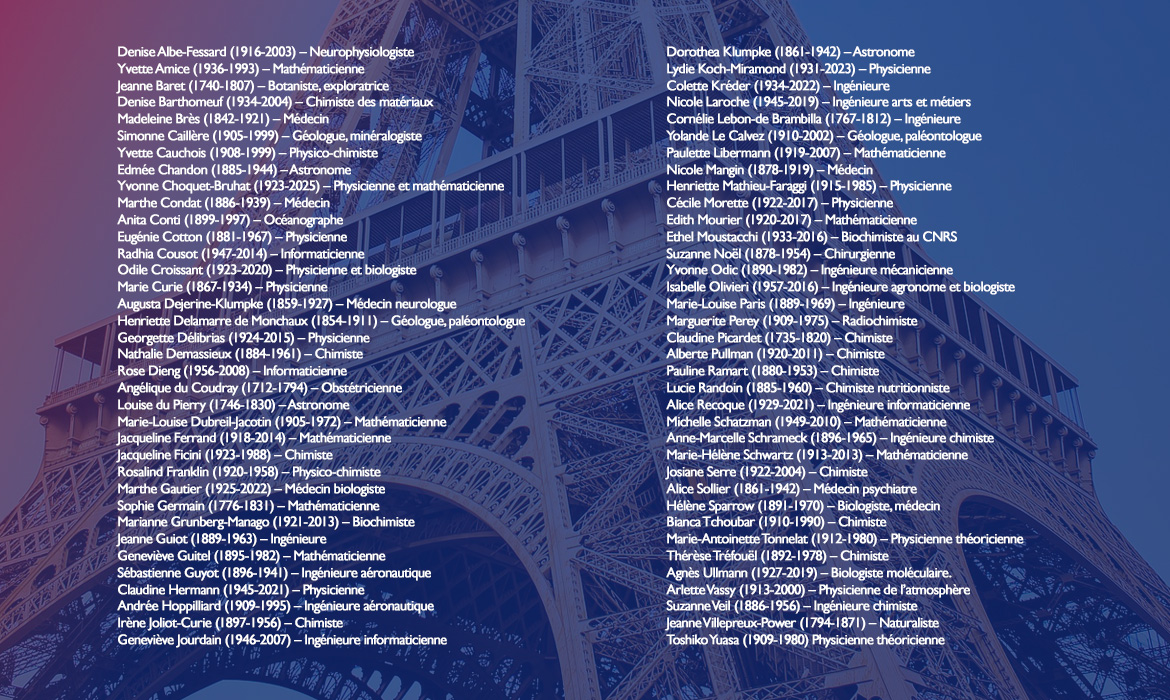
That is about to change. In January 2026, a landmark initiative was officially presented to the City of Paris: the inscription of 72 women scientists on the Eiffel Tower, finally giving public recognition to women whose contributions shaped science in France and beyond.
The project is the result of several years of work led by the association Femmes & Sciences, with strong institutional backing from the CNRS. Inspired by the symbolic absence of women on the monument, the initiative seeks to correct what historians call the “Matilda effect”—the systematic invisibility of women’s scientific achievements. Currently, the tower displays the names of 72 male scientists, chosen by Gustave Eiffel himself, engraved in gold on the first floor. These names celebrate the scientific optimism of the late 19th century, but they also reflect the gender biases of that era.
Initially, the proposal aimed to add 40 women scientists to the second floor of the tower. However, after careful study by a multidisciplinary commission, the recommendation evolved into something far more ambitious: inscribing 72 women scientists on the first floor, directly above the existing male names, using the same golden lettering and techniques. This approach preserves the monument’s aesthetic and historical integrity while sending a powerful message of equality.
The commission brought together heritage experts, historians, cultural institutions, descendants of Gustave Eiffel, and leading scientists connected to the CNRS. Their shared goal was not only symbolic recognition, but also historical accuracy and educational impact. Two clear principles guided the selection of names: the women must be French or have had a strong scientific link to France, and they must be deceased. Unlike the male list from the 18th and 19th centuries, this new selection spans a much broader timeline, including pioneers of the 20th and even 21st centuries.
Among the 72 women chosen are world-renowned figures such as Marie Curie, a two-time Nobel Prize winner, as well as lesser-known but equally vital contributors in fields ranging from mathematics and physics to biology, medicine, engineering, and computer science. The list reflects the extraordinary diversity of scientific disciplines in which women have excelled—often against significant social and institutional barriers.
The CNRS played a central role in supporting the initiative, ensuring that national research organizations were consulted during the selection process. Final validation involved expert review by the French Academy of Sciences and the Academy of Technologies. On January 26, 2026, the completed list was officially handed to Paris Mayor Anne Hidalgo, marking a decisive step toward implementation.
Because the Eiffel Tower is a protected historic monument, administrative and legal procedures are still required before the inscriptions can be physically added. Once approved, the project will be accompanied by a major cultural and educational program. Exhibitions, educational resources, and public outreach initiatives will aim to inspire younger generations—especially girls—to envision themselves in scientific careers.
More than a symbolic gesture, this initiative reshapes how scientific heritage is presented in public spaces. By engraving the names of women scientists alongside those of men, the Eiffel Tower will finally reflect a more complete, inclusive history of science—one that acknowledges brilliance, perseverance, and innovation, regardless of gender.